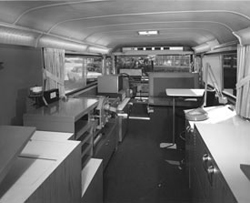

Visitors find the elevated a convenient and pleasant way of getting around the city, as it affords some good views. The New Yorker always chooses the subway, the quickest way – if he can get an express. If he must take a local for a few blocks, he changes to an express as soon as possible.
I found this today in a box of bits and pieces I haven’t looked at in years. It reminds me that I was once asked, in all sincerity, whether the NYC subway system was built before the city.
It also suggests that like the High Line perhaps, the El was designed for tourists – that real New Yorkers travel as fast as they can, underground.
16 August 2009 New York 1 comment
-
Joel Sternfeld, 11th Avenue and 30th Street looking east, Spring
The High Line used to be one of NYC’s mysteries. When I lived in New York in the mid- to late-nineties, I’d often wonder about this stretch of disused elevated railway. So many famous photographs of New York feature street life in the shadows of the Second Avenue El; the High Line served as reminder of this older type of city landscape. Also, for much of the time I lived in New York, I slept with my head meters from another set of elevated tracks in West Harlem; the view from my window above my bathtub stretched north along the tracks, the Hudson River to the left, the George Washington Bridge framing the horizon. I loved the neighbourhood sheltered under the Henry Hudson Parkway and the elevated line: the meatpacking plants, the strip joints, the autobody shops, the community of fisherman clustered on the pier at the end of 125th Street. Sometimes the light filtering through the tracks would cast the street below in bamboo blind-like stripes of light and dark straight out of a Berenice Abbott photograph.
I first thought about trespassing on the High Line when I read Lisa and Michael’s accounts of doing so. At the time, I thought I was up for it; took my camera, made my way to the on-ramp through the truck lot below the Javits Center. I loitered a bit. Thought about barbed-wire, about being lost, getting caught. I chickened out. It’s a regret, but not a huge one. I’ve looked at Joel Sternfeld’s photographs a lot over the years and have been very glad of them. I shuddered whilst reading reports of redevelopment proposals. But some of the things I’ve heard make it seem like it’s worked out. One is Bill Cunningham’s report. (If you don’t know Bill Cunningham, read this.) I’m not overly interested in clothes, but I love his On The Street reports, his enthusiasm, optimism, the way he says “maaaaarvellous.” He is ebullient most of the time, but he’s absolutely beside himself talking about the High Line: he sees the future of America in it. Visit if you can, and let me know what you think.
13 August 2009 2 comments

I have trouble reading instructions. I sometimes skip #1, under the presumption that it is probably introductory, like, Hello or Get ready or This won’t be as painful as you think. Generally however, I’ve found #1 to be quite important, if not crucial.
I fixed an electronic device tonight using a butter knife. Without consulting an instruction manual.
23 July 2009 letterpress no comments
Here’s something I read the other night after I finally took my sorry, sad-sack self to bed:
David Trubridge (interviewed in the most recent issue of Dumbo Feather): …..That’s where I think craft is so important, because imbedded in craft is the model of caring. It’s not producing stuff to sell, to make a profit, to keep the shareholders of the business happy. It’s making stuff because you want to make it, and you care about making it, and you use the best materials and processes because you want it to last. It’s innate in craft that you care. I think that is really important, that we should elevate it more and give it more attention and place in our lives.
Yes, I thought, yes. It is about care, and attention, and if that sometimes spirals into a somewhat unhealthy preoccupation with perfection, well, then that’s the cost of caring. I feel a bit better about this now. Thanks, too, to those of you who sent messages of support and solidarity. At risk of offending former therapists, I find Twitter just as efficacious as psychotherapy.
*****
And, for Melbourne readers, something else I read recently which might strike a cord:
This is how Romans cope with the cold: every year everyone declares ‘it never gets this cold’ and in this way, even though it gets this cold every year, enough rhetorical heat is generated to get through the unseasonably seasonable cold. You are better off in a seriously cold place like England. – Geoff Dyer.
Sound familiar?
15 July 2009 craft 1 comment
In my first year of secondary school Science, each student was randomly assigned a rock or mineral as a research project. Others had diamond or emerald or ruby; mine was quartz. Turns out, almost everything is a kind of quartz, and my assignment turned into an encyclopaedia of quartz, with a chapter on each kind and hand-drawn illustrations. My parents drove me to Geelong (a good hour away) to meet with a friend of my grand-aunt who was a rock collector. This old man gave me rock samples for a display case I’d made out of a plastic shirt box.
Later, I continued this obsessiveness with a Geography project on the Mallee (a geographic area in my state) which included chapters on the Mallee root (don’t ask) and the Mallee fowl. I got a C on this assignment because I was three days late handing it in; I’d spent weeks getting up at 3 or 4 in the morning to work on it. In History, I was asked to collect 20 newspaper articles on apartheid in South Africa and to write a paragraph on each. I became overwhelmed by the hundreds and hundreds of articles I’d collected, didn’t hand in anything at all and got a shameful 52 for the semester.
I’m telling you this because I’ve been thinking about perfectionism; about the fine line between working on the edge of one’s abilities and being in way over one’s head. Mulling over the role of perfectionism in my own life is of course just part of broader, more generalised brooding over How To Live, and the internet has lots of ideas about this. I’m particularly taken with the programs at London’s School of Life; I’d like to commit myself (in the psychiatric sense) to a long-term residential stay. The School’s blog directed me to Richard Herring’s series on Bad Habits, which, in his opinion, include procrastination, lateness, laziness, perfectionism and workaholism. Unfortunately, the links to procrastination, lateness and perfectionism appear to be busted, so no help there.
Then I happened to read a piece in the NYT about a man’s re-evaluation of his father, years after the father’s death. A man who, for intents and purposes, was difficult, erratic and, basically, mad was, the author now sees, driven to this by the sheer frustration of managing his maddeningly obsessive compulsions. Ironically, the author discovers another side to his father through correspondence with one of his father’s underlings at the paper where the father was a senior editor. It becomes clear that in his role as editor, his obsessiveness was an asset; at home, a severe liability.
I’m guessing that all of us grapple in one way or another with these kinds of issues? Big picture/small picture, forest/trees, it’s hard to keep it all together. I can spend absorbing hours moving letters micro-millimetres around a page, or wondering about the use, under- or over-, of the comma, when all sorts of other aspects of my life are chaos. I guess what I’m circling around is the discomforting idea that the things that I’m good at (discerning gradations of ink, re-arranging paper fibres, judging something to be square) might not be evidence of skill so much as evidence of the worst aspects of my personality. Or maybe not the worst exactly, but not great. Hmmm. Where is this going? How about you? Is perfectionism the dark underbelly of craft? Are your neuroses reflected in the type of creative work you choose to do?
13 July 2009 2 comments

Tucked into my copy of The Undergraduate and the Graphic Arts by Ray Nash, graphic arts educator and historian, are two clippings advertising the talk Nash gave for the Heritage of the Graphic Arts series at Gallery 303, The Composing Room, 130 West 46th Street, NYC, on 23 April, 1969.
This series grew out of the activities of the Typophiles, under the stewardship of the remarkable Dr. Robert Leslie. (Erin Malone’s wonderful research first introduced me to Dr. Leslie years back.) Apprenticed to the great Theodore Low De Vinne, Leslie continued to work in the printing industry while he put himself through medical school. Appointed McGraw-Hill’s first industrial doctor, Leslie lost his eye in a chemical explosion at their printing plant in Manhattan. Giving up medicine (his wife, obsetrician and gynecologist Sarah Greenberg, the “Angel of Williamsburg”, claimed there was only room for one doctor in their marriage), Leslie returned to the printing industry, soon opening The Composing Room, a typesetting business, with linotype operator Sol Cantor. Leslie championed the work of European emigrés fleeing Nazi-occupied Europe, launching their American careers in his magazine PM (later re-named A-D.) His gallery was the first to showcase graphic and typographic art in the US. Late in life, realising a long-held dream, he established Uncle Bob’s Paper Mill in the Negev Desert, Israel, producing paper made with mitan, a locally-grown fibre. An enthusiastic Typophile, he instituted trips to places of typographic interest that he dubbed “junkets”; the attendees “junketeers.”
Ray Nash, eminent teacher at Dartmouth College, gave his talk about 16th century printers and their methods at Leslie’s gallery. One of the clippings I have advertising his talk features a formal photo of Nash in profile, and the wonderful headline: They had problems, too.
7 May 2009 typography no comments


The Universal Mono-Tabular Broach (US Patent Numbers 2153890-2338940) was, according to promotional copy, “the most versatile an inexpensive rule form system ever devised.” It is “a machine with punches that may be spaced to broach horizontal metal rules so that vertical rules may be inserted to register most all kinds of forms within two minutes or less.”
The Universal Mono-Tabular Corporation (706 Olive Street, Dallas 1, Texas) addresses her customers on the last page of the machine manual:
It is our sincere desire that you shall always derive from your Mono-Tabular Broach the full measure of service, speed and ease of production that we have earnestly built into it, and with the installation of this equipment in your plant, we trust, will be the beginning of a very pleasant business relationship between us.
May it grow closer as the years pass.
I almost blush to read this.
1 May 2009 letterpress 2 comments